Meet the free, proud, independent people of Ukraine: https://www.youtube.com/watch?v=yzNxLzFfR5w Nothing but reviews. In excess.
From ZERO to 6 ♥s. 100% ad-free. Run on pure love for movies, documentaries and TV-series. June 2025: Countdown to: Top 10: Best horror comedy movies - Upcoming review: There's Still Tomorrow (2023)
Eagerly anticipating this month ... (6-25)
Joachim Trier's Sentimental Value (2025)
Showing posts with label Sessue Hayakawa. Show all posts
Showing posts with label Sessue Hayakawa. Show all posts
Jerry Lewis looks his trademark loony self on this bright and colorful poster for Frank Tashlin's The Geisha Boy
An American magician without much traction in his career flies to Japan to help entertain US troops there, but soon a local orphan boy clings to him...
The Geisha Boy is written and directed by Frank Tashlin (The First Time (1952)), based on a story by Rudy Makoul (Teenage Thunder (1957)).
As often the case in Jerry Lewis' (Boeing, Boeing (1965))/Tashlin films, the level is unsteady: Lewis is too much, and a bit later he is funny, and then a bit later too much again and ...
The story is somewhat bizarre: Lewis ridicules Japanese in some sequences, but the boy simply loves him regardless. (Still, the bizarro factor is surely higher in Lewis' infamous lost Holocaust clown movie, The Day the Clown Cried (1972).)Little Robert Hirano as the orphan boy is unbeatably cute.
[The Geisha Boy premiered 3 December (Chicago) and runs 99 minutes. Shooting took place from June - August 1958 in California, including Los Angeles. The film recorded 1.3 mil. admissions in France but other release details are regrettably scarce online. Tashlin returned with Say One for Me (1959). Lewis returned in Don't Give Up the Ship (1959). 1,807 IMDb users have given The Geisha Boy a 6.5/10 average rating.]
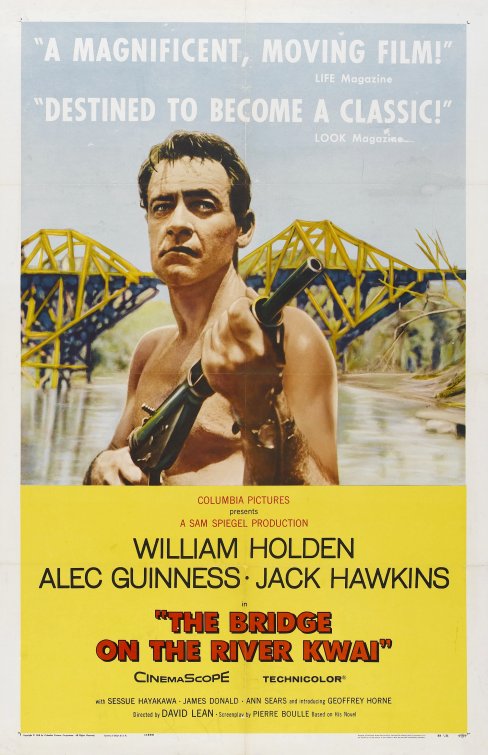
Co-star Alex Guinness looks paranoid while holding a riffle in front of his precious bridge on this evocative poster for David Lean's The Bridge on the River Kwai
A large group of British prisoners of war in Japanese-occupied Burma in 1942 get as forced assignment to build a bridge for the railway. The mentally deteriorating British Colonel Nicholson in charge puts all of his pride into the project, which is to symbolize the unparalleled craftsmanship and unbreakable will of the British, he announces, while other allies are sent on a deadly sabotage mission through the hostile jungle towards the self same bridge.
The Bridge on the River Kwai is written by Carl Foreman (The Key (1958)) and Michael Wilson (Salt of the Earth (1954)), adapting the same-titled 1952 novel by Pierre Boulle (La Planète des singes/Planet of the Apes (1963)), and directed by English master filmmaker David Lean (This Happy Breed (1944)), whose 11th feature it was. Kwai is an unequaled masterpiece in the suspense-based war movie genre. It is inspired by facts, but is for the most part fiction, as the real life parallel, the Japanese-led construction of the Burma-Siam railway, was actually much more terrible and deadly than the events depicted in the film. (13,000 war prisoners and between 80,000-100,000 civilians died as a result of the project; Nicholson is also entirely fictional.) The film has some of the most exciting suspense scenes in all of cinema, and yet most of this epic relies on unforgettable, insightful character studies: There's the pragmatist doctor, who sees only pointlessness in the trials of the war; the zealous major, who makes it a matter of personal spite and principal to prove the Japanese inferior to the British. And there's the Japanese colonel Saito, who buds heads with the Brit and follows his own culture's specific codes of conduct. Alec Guinness (Star Wars V: The Empire Strikes Back (1980)) portrays Major Nicholson brilliantly, a character whose rigid mind and jungle fever takes him to the blinded edge of sanity. Sessue Hayakawa (The Geisha Boy (1958)) is also supreme as Saito. The scenes between the two are some of the film's best. Highly sophisticated, intense and alive.
In other supporting roles, Jack Hawkins (To Bury Caesar (1963)) and William Holden (The Towering Inferno (1974)) are enjoyable. The film is also unusual in that it is almost entirely bereft of women. The Bridge on the River Kwai is one of the best war films of all time, an eminent epic, and it has been restored beautifully. It is a must watch for every movie-lover out there, and especially so for the war-interested ones.
Cost: 3 mil. $ Box office: 30.6 mil. $ = Mega-hit (returned 10.6 times its cost)
[The Bridge on the River Kwai premiered 2 October (London) and runs 161 minutes. The film's American writers wrote the screenplay in British exile due to being on the McCarthy blacklist, and this also prompted non-English speaking Boulle to become credited with its writing. Foreman was paid 17k $ for the job. Guinness was paid 150k $; Holden 250-300k $ (different reports) plus 10% of the worldwide gross. Shooting took place from November 1956 - May 1957 in Sri Lanka. Lean had serious disagreements with Guinness during filming and also at one point nearly drowned in the river. A scene with a woman was shot solely to appease US studio Columbia. The film earned 17.1 mil. $ (55.9 % of the total gross) in North America: It was Columbia's highest-grossing at the time and the global top-grosser of the year, as well as the highest-grossing of the year in North America and the UK. It was nominated for 8 Oscars, winning 7: For Best Picture, Actor (Guinness), Cinematography (Jack Hildyard (Emily (1976))), Director, Editing, Score (Malcolm Arnold (Hard Times (1977, miniseries))) and Adapted Screenplay; losing Supporting Actor (Hayakawa) for Red Buttons in Sayonara. It also won 4 BAFTAs, a David di Donatello award, 3/4 Golden Globe nominations, was nominated for a Grammy, won 5 National Board of Review awards, among other honors. The first TV screening of the film was in 1962 on ABC, with a record result of 72 mil. viewers. Warren Buffett has said that it is his favorite film. IMDb's users have rated the film in at #171 on the site's Top 250 list, sitting between Trainspotting (1996) and Klaus (2019, VoD). Lean returned with Lawrence of Arabia (1962). Holden returned in The Key (1958); Guinness in All at Sea (1957); and Hawkins in Terror! Theatre (1957, TV-series), The World Our Stage (1958, TV-series) and theatrically in Gideon of Scotland Yard (1958). The Bridge on the River Kwai is certified fresh at 96 % with a 9.40/10 critical average at Rotten Tomatoes.]
What do you think of The Bridge on the River Kwai?