Eagerly anticipating this month ... (6-25)

Eagerly anticipating this month ... (6-25)
Joachim Trier's Sentimental Value (2025)
Showing posts with label Carl Foreman. Show all posts

1/22/2023

High Noon (1952) - Cornered sheriff Cooper in Zinnemann's iconic western

♥♥♥♥♥


A fabulous old-timey poster made with superb craftsmanship for Fred Zinnemann's High Noon

Newly-wed, soon-retiring sheriff Will Kane of the small town of Hadleyville in New Mexico Territory gets himself an unwelcome piece of news, when it becomes clear that a murderer that he put behind bars and who swore him dead has been released and is presently returning to town on the noon train!


High Noon is written by Carl Foreman (The Key (1958)), partly based on the short story The Tin Star (1947) by John W. Cunningham (Warhorse (1956)), and directed by Austrian-Hungarian/American master filmmaker Fred Zinnemann (Redes (1936)).

It is an iconic American film with Gary Cooper (Dallas (1950)) as the man who must do the right thing in a town that's not worth much. Grace Kelly (Fourteen Hours (1951)) is wonderful as his Quaker wife; Katy Jurado (Evita Peron (1982, TV movie)) is good as the Mexican beauty Helen Ramírez that's between Cooper and Lloyd Bridges (Cross of Fire (1989, TV movie)) on the brink of madness. With a very disillusioned Lon Chaney Jr. (Apache Uprising (1965)) and a kinkily scowling Lee Van Cleef (Arena (1953)) in his screen debut, the film also has wonderful, clear images (cinematography by Floyd Crosby (Tales of Terror (1962))) and a strikingly composed, strong score by Dimitri Tiomkin (The Unforgiven (1960)).

High Noon at times may seem so iconic as to feel distant to me, but it is certainly a formidable western.


Related post:


Fred Zinnemann: From Here to Eternity (1953) - Zinnemann, Taradash and Jones' Hawaii-set classic


Watch a trailer for the film here


Cost: 730k $

Box office: Reportedly 12 mil. $

= Mega-hit (returned 16.43 times its cost)

[High Noon premiered 1 May (London) and runs 85 minutes. Reportedly Foreman had made a 4-page outline that was similar to Cunningham's story, so that he purchased the rights to it before writing the script. Meanwhile he was questioned at the HUAC (House Un-American Comittee) in Washington over past membership of the Communist Party. Failure to name names designated him an 'uncooperative witness', and Foreman consequently left the US, as this landed him on the Hollywood blacklist. Cooper was paid 60k $ and an unspecified percentage of the film's profits for his performance. Shooting took place from September - October 1951 in California. The film made reportedly 3.4 mil. $ at the North-American box office in 1952. Howard Hawks and John Wayne were vocally opposed to the film and its alleged un-American values and made Rio Bravo (1959) in response. It was nominated for 7 Oscars, winning 4: Best Actor, Editing, Song (High Noon (Don't Forsake Me, Oh My Darlin') by Tiomkin and Ned Washington) and Score - Drama/Comedy. It lost Best Director to John Ford for The Quiet Man, Picture to The Greatest Show on Earth and Screenplay to Charles Schnee for The Bad and the Beautiful. It also won 4/7 Golden Globe nominations and a National Board of Review award, among other honors. Zinnemann returned with The Member of the Wedding (1952). Cooper returned in Springfield Rifle (1952). High Noon is certified fresh at 94 % with an 8.80/10 critical average at Rotten Tomatoes.]


What do you think of High Noon?

12/30/2020

The Guns of Navarone (1961) - Thompson's wonderful war-adventure classic

♥♥♥♥♥


The starry cast encased in striking Greek columns make up this exciting poster for J. Lee Thompson's The Guns of Navarone


WWII: 2,000 British prisoners of war are set to be executed, after they have been captured by Axis powers on a Greek island, if the Navy fail to break them free; but the Nazis have two enormous cannons, which hinder the rescue operation.


The Guns of Navarone is written by writer/producer Carl Foreman (Young Man with a Horn (1950)), adapting the same-titled 1957 bestseller by Alistair McLean (South by Java Head (1958)), and directed by great British filmmaker J. Lee Thompson (Murder Without Crime (1950)).

The film is a rare, wonderful war adventure. Gregory Peck (Yellow Sky (1948)) as Captain Mallory get the 'impossible mission', and he and David Niven (Goodyear Theatre (1957-58)) as a pedantically philosophizing chaplain have some really good scenes together, especially when Peck, - who has one of his career's best heroic parts here, - puts Niven in his place. Anthony Quayle (Jarrett (1973, TV movie)) with gangrene, and a bitter Anthony Quinn (The Message (1976)) are also terrific in the fine cast.

The Guns of Navarone is grand, a beautiful production with a great Dimitri Tiomkin (Blowing Wild (1953)) score. Technically there are shots in the film that are lacking a bit in quality. But this is a very minor note to a really wonderful film.


Related posts:

J. Lee Thompson: Battle for the Planet of the Apes (1973) or, The Final Ape!
Conquest of the Planet of the Apes (1972) or, The Ape Uprising

Cape Fear (1962) - Great suspense in effective home invasion thriller 


 Writer-producer Foreman discusses the film in a 2-minute clip here


Cost: 6 mil. $

Box office: 25 mil. $ (worldwide rentals); likely gross of 55.5 mil. $

= Mega-hit (likely returned around 9.25 times its cost)

[The Guns of Navarone premiered 27 April (London) and runs 158 minutes. MacLean's novel was inspired by the Battle of Leros during WWII. Head of Columbia Pictures Mike Frankovich had read the novel and passed it excitedly on to Foreman to adapt. Alexander Mackendrick was set to direct but was fired a week prior to shooting over 'creative differences'. Shooting took place in Senegal, Greece, England, Mexico and in Los Angeles from February - July 1960. Niven got seriously ill and nearly died after filming in the pool of water beneath the cave elevator and was hospitalized for weeks, as production continued but under great uncertainty. He finally recovered and was able to complete his scenes. Peck's German was dubbed. Several members of the Greek royal family visited the set and were used as extras in the Mandrakos café scene. The film stays close to the novel; the island of Navarone is fictional. Queen Elizabeth II and Prince Philip attended the London premiere. The film was a great success, grossing 28.9 mil. $ in North America, with rentals of 13 mil. $. With worldwide rentals of 25 mil. $, if multiplied accordingly, the world gross would be 55.5 mil. $. The film was the year's 2nd highest-grossing of all, after West Side Story. It was nominated for 7 Oscars; it won the Best Special Effects Oscar, and lost Best Director to Robert Wise and Jerome Robbins for West Side Story, Editing to West Side Story, Drama/Comedy Score to Henry Mancini for Breakfast at Tiffany's, Picture to West Side Story, Sound to West Side Story and Adapted Screenplay to Abby Mann for Judgment at Nuremberg. It also won 2/3 Golden Globe nominations, and was nominated for a BAFTA and a Grammy among other honors. MacLean's 1968 sequel novel (the only sequel he ever wrote) was adapted as the same-titled Force 10 from Navarone (1978), without any of the talent of the original film involved; it was unsuccessful. Thompson returned with Cape Fear (1962). Peck returned in that film; Niven in The Best of Enemies (1961); Quinn in Barabbas (1961). The Guns of Navarone is certified fresh at 92 % with a 7.93/10 critical average at Rotten Tomatoes.]


What do you think of The Guns of Navarone?

2/10/2015

Cyrano de Bergerac (1950) or, Does She? Does He? - Oh, Love!

♥♥♥

A saturated poster for Michael Gordon's Cyrano de Bergerac

QUICK REVIEW:

Cyrano is a big-nosed, attention-seeking orator, who affronts and fascinates Paris with his genius. He is striving for love, but he can only experience it as a rhetorical stand-in for a beautiful man.

This the first English-language adaptation of the classic 1897 play features handsome sword fights and dated cannon battles. The dialog in Carl Foreman's (The Guns of Navarone (1961)) screenplay is, at times, too dense, but Puerto-Rican actor José Ferrer (The Caine Mutiny (1954)) is outstanding in the all-important title lead, - which is also the performance that won him his career's only Oscar.
Cyrano de Bergerac is a dated but entertaining action love-tragedy. It is available in public domain here, but in shabby quality. For a clearer image and sound, you can also buy it on DVD and Bluray.
It is directed by Baltimorean director Michael Gordon (Pillow Talk (1959)).


José Ferrer in the nose-prosthetics and costume get-up for the role that earned him his only Oscar, as Michael Gordon's Cyrano de Bergerac


Watch the trailer here

Cost: 1.1 mil. $
Box office: 1.9 (US rentals only)
= Minor flop
[Cyrano de Bergerac was made for a smaller budget than other costume pictures of the type at the time because of fear it could flop, which it then ended up doing. It reportedly resulted in a 300k $ loss.]

What do you think of this version of Cyrano de Bergerac?
If you've seen others, do tell about it/them

11/28/2013

The Bridge on the River Kwai (1957) - One of the all time greats

♥♥♥♥♥♥


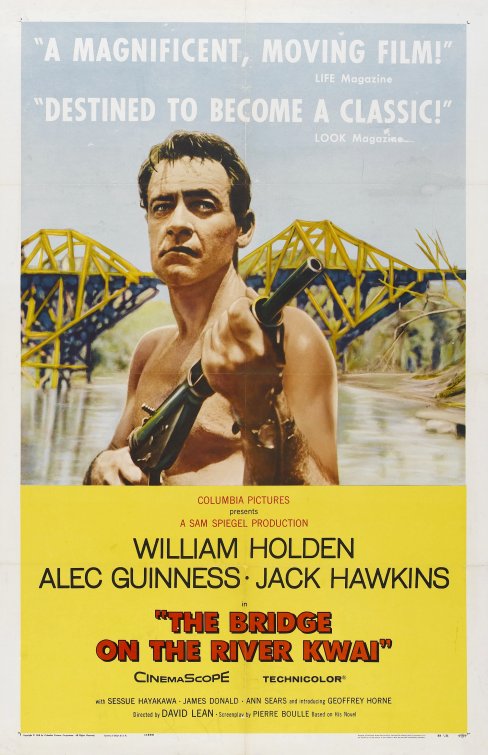
Co-star Alex Guinness looks paranoid while holding a riffle in front of his precious bridge on this evocative poster for David Lean's The Bridge on the River Kwai


A large group of British prisoners of war in Japanese-occupied Burma in 1942 get as forced assignment to build a bridge for the railway. The mentally deteriorating British Colonel Nicholson in charge puts all of his pride into the project, which is to symbolize the unparalleled craftsmanship and unbreakable will of the British, he announces, while other allies are sent on a deadly sabotage mission through the hostile jungle towards the self same bridge.


The Bridge on the River Kwai is written by Carl Foreman (The Key (1958)) and Michael Wilson (Salt of the Earth (1954)), adapting the same-titled 1952 novel by Pierre Boulle (La Planète des singes/Planet of the Apes (1963)), and directed by English master filmmaker David Lean (This Happy Breed (1944)), whose 11th feature it was.
Kwai is an unequaled masterpiece in the suspense-based war movie genre. It is inspired by facts, but is for the most part fiction, as the real life parallel, the Japanese-led construction of the Burma-Siam railway, was actually much more terrible and deadly than the events depicted in the film. (13,000 war prisoners and between 80,000-100,000 civilians died as a result of the project; Nicholson is also entirely fictional.)
The film has some of the most exciting suspense scenes in all of cinema, and yet most of this epic relies on unforgettable, insightful character studies: There's the pragmatist doctor, who sees only pointlessness in the trials of the war; the zealous major, who makes it a matter of personal spite and principal to prove the Japanese inferior to the British. And there's the Japanese colonel Saito, who buds heads with the Brit and follows his own culture's specific codes of conduct.
Alec Guinness (Star Wars V: The Empire Strikes Back (1980)) portrays Major Nicholson brilliantly, a character whose rigid mind and jungle fever takes him to the blinded edge of sanity. Sessue Hayakawa (The Geisha Boy (1958)) is also supreme as Saito. The scenes between the two are some of the film's best. Highly sophisticated, intense and alive.

In other supporting roles, Jack Hawkins (To Bury Caesar (1963)) and William Holden (The Towering Inferno (1974)) are enjoyable. The film is also unusual in that it is almost entirely bereft of women.
The Bridge on the River Kwai is one of the best war films of all time, an eminent epic, and it has been restored beautifully. It is a must watch for every movie-lover out there, and especially so for the war-interested ones.


Related posts:


David Lean: Top 10: Best epic movies reviewed by Film Excess to date

Top 10: Best UK movies reviewed by Film Excess to date

Great Expectations (1946) - Lean's first Dickens adaptation is pure cinema magic 


Watch a trailer for the film here


Cost: 3 mil. $
Box office: 30.6 mil. $
= Mega-hit (returned 10.6 times its cost)

[The Bridge on the River Kwai premiered 2 October (London) and runs 161 minutes. The film's American writers wrote the screenplay in British exile due to being on the McCarthy blacklist, and this also prompted non-English speaking Boulle to become credited with its writing. Foreman was paid 17k $ for the job. Guinness was paid 150k $; Holden 250-300k $ (different reports) plus 10% of the worldwide gross. Shooting took place from November 1956 - May 1957 in Sri Lanka. Lean had serious disagreements with Guinness during filming and also at one point nearly drowned in the river. A scene with a woman was shot solely to appease US studio Columbia. The film earned 17.1 mil. $ (55.9 % of the total gross) in North America: It was Columbia's highest-grossing at the time and the global top-grosser of the year, as well as the highest-grossing of the year in North America and the UK. It was nominated for 8 Oscars, winning 7: For Best Picture, Actor (Guinness), Cinematography (Jack Hildyard (Emily (1976))), Director, Editing, Score (Malcolm Arnold (Hard Times (1977, miniseries))) and Adapted Screenplay; losing Supporting Actor (Hayakawa) for Red Buttons in Sayonara. It also won 4 BAFTAs, a David di Donatello award, 3/4 Golden Globe nominations, was nominated for a Grammy, won 5 National Board of Review awards, among other honors. The first TV screening of the film was in 1962 on ABC, with a record result of 72 mil. viewers. Warren Buffett has said that it is his favorite film. IMDb's users have rated the film in at #171 on the site's Top 250 list, sitting between Trainspotting (1996) and Klaus (2019, VoD). Lean returned with Lawrence of Arabia (1962). Holden returned in The Key (1958); Guinness in All at Sea (1957); and Hawkins in Terror! Theatre (1957, TV-series), The World Our Stage (1958, TV-series) and theatrically in Gideon of Scotland Yard (1958). The Bridge on the River Kwai is certified fresh at 96 % with a 9.40/10 critical average at Rotten Tomatoes.]


What do you think of The Bridge on the River Kwai?

Eagerly anticipating this month ... (5-25)

Eagerly anticipating this month ... (5-25)
Kleber Mendonca Filho's The Secret Agent (2025)